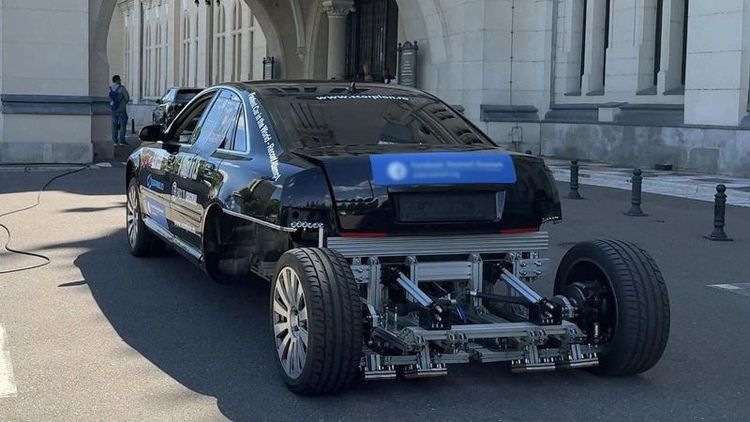
Romanian startup Rosmar H has introduced an unusual experimental vehicle called the Rosmar V-04. The prototype does not use a conventional internal combustion engine, an electric motor, or a traction battery.
Instead, the developers have created a pneumatic system based on compressed-air cylinders. These cylinders generate rapid mechanical impulses that are transferred to the rear axle, producing the force required to move the vehicle.
At the moment, the Rosmar V-04 exists only as an early-stage prototype and can move at relatively low speeds. However, its creators have suggested that the technology could eventually have far more ambitious performance potential.
How the Pneumatic System Works
The vehicle's propulsion system is based on pneumatic cylinders connected to the rear section of the car. When compressed air is released into the system, the cylinders perform rapid back-and-forth movements and transfer mechanical force to the wheels.
One of the most unusual features of the design is that the rear wheels do not simply rotate. During operation, they also move forward and backward along specially designed guides.
Visually, the mechanism resembles industrial pneumatic equipment more than a conventional automotive drivetrain.
According to the developers, this principle could improve the way the wheels interact with the driving surface and potentially provide better traction in challenging conditions.
Potential Advantages on Slippery Surfaces
The Rosmar H team believes the technology could be particularly useful on snow, mud, loose terrain and other slippery surfaces.
Instead of relying solely on conventional torque delivery, the system uses short mechanical impulses. In theory, this could help the wheels maintain better contact with the ground.
Why the System Is Used Only at the Rear
Applying the same mechanism to all four wheels would require significant additional space, as each wheel needs room to move longitudinally.
The challenge is even greater at the front axle, where the wheels must also steer the vehicle. Additional forward and backward movement could potentially affect vehicle stability and steering precision.
For this reason, the current Rosmar V-04 prototype uses the pneumatic propulsion system exclusively on the rear axle.
Even in this configuration, the wheels can extend beyond the vehicle's normal body dimensions while the mechanism is operating. Any future production version would therefore require additional protective elements to ensure the safety of passengers, pedestrians and other road users.
Compressed-Air Cars Are Not a New Concept
The idea of using compressed air to power a vehicle has been explored for decades.
One of the best-known projects was French company MDI, founded by engineer Guy Nègre in the early 1990s. The company developed several compressed-air vehicle concepts and at one point planned cooperation with Tata Motors.
Such systems generally rely on high-pressure compressed air stored in special tanks and used to drive mechanical components.
However, one of the major challenges is that compressed air is not a primary source of energy. It must first be produced using a compressor powered by electricity or another external energy source.
As a result, the overall efficiency of a compressed-air vehicle depends not only on the vehicle itself but also on how the air is generated, compressed, stored and delivered.
An Experimental Project for Now
The Rosmar V-04 remains an experimental development built on the platform of an older Audi model.
Before such a system could be introduced into mass production, its developers would need to demonstrate its safety, reliability, energy efficiency and compatibility with modern automotive manufacturing requirements.
For now, the Rosmar V-04 is better described as an unconventional engineering experiment rather than a production-ready alternative to conventional gasoline, hybrid or electric vehicles. Nevertheless, the project demonstrates that engineers continue to explore new and unconventional approaches to vehicle propulsion.